
Begin a Wallingford Resident Search
A good search separates five relationships that often look alike. A parcel owner holds title. A mailing addressee receives tax mail. A registered voter gave an address to election officials. A party in a court case appears because of a legal matter. A printed directory entry reports what a publisher gathered in one year. None of those labels alone is a complete household list.
Start with the most exact item available and keep a short log. Record the spelling, address form, source date, and result. Wallingford is in New Haven County for geographic and court purposes, but Connecticut ended county government in 1960. There is no county recorder or assessor to call. Town and state custodians are the working route.
A name-only question needs the most care. Wallingford's older directories use initials, married-name forms, spouse names in parentheses, and business entries beside household entries. Modern court and license indexes can also return several people with the same name. Add a middle initial, street, parcel, record date, or known role one fact at a time. If a portal gives no result, change the spelling and search field before concluding that no record exists.
- Search Vision by owner or street address and record the parcel ID, situs address, and mailing address.
- Check Connecticut's individual voter lookup when the person and town are known.
- Use the Town Clerk's land index to connect a name with deeds, mortgages, releases, liens, maps, or surveys.
- Search Judicial Branch indexes by party name, docket number, or foreclosure property address when a court trail is relevant.
- Move to Wallingford Public Library directories and historical sources for an older household.
Online access is only one channel. The Town Clerk counter holds older land material and supplies certified copies. Library staff retrieve closed-stack Connecticut Collection items. State vital-record offices accept the forms documented for each certificate, and a Connecticut Freedom of Information Act request can reach an existing nonexempt agency record that is not posted. The law does not require an office to create a new household list or answer a research question.
A phone number offers a different starting point. The town's public phone directory routes calls to municipal departments, not private households. Historical telephone and city directories may index an old number, but numbering plans and subscribers change. Search the number exactly as printed, then remove punctuation or compare the surname and address on the same directory page. A modern reverse result without a named official source needs confirmation through a dated public record.
Wallingford's Resident Record Custodians
Three town desks create much of the local records directory. The Town Clerk records land instruments and handles local vital certificates, trade names, maps, election material, and other filings. The Assessor maintains ownership and valuation facts. The Registrar of Voters maintains the local list within Connecticut's centralized system. Court and statewide vital searches go to state agencies.
Wallingford Town Clerk
45 South Main Street, Room 108
Wallingford, CT 06492
203-294-2145
The offices share an address but not a database. An assessor card cannot certify title. A deed index does not show each person who sleeps at the property. A voter entry is controlled by election law, and a vital certificate follows eligibility rules that differ by record type and age. Send a narrow request to the actual keeper and include the name, approximate date, address, and record type. That detail helps staff locate a book, file, image, or list without asking them to build a new report.
Wallingford Town Clerk recordings are accepted during the public workday but stop before the building closes. Difficult pre-digital land searches belong at the counter. The Assessor can explain the Grand List, property card, sales record, or exemption field. The registrar maintains computerized voter files, card files, district lists, and election records, while absentee ballot applications go through the Town Clerk. Confirm each office's current schedule before traveling.
Search Wallingford Parcels First
The Vision Government Solutions search is the fastest current ownership check. It accepts owner, street number, street name, account, MBLU, PID, or an all-fields query. MBLU is the map, block, lot, and unit identifier. PID is the portal's parcel identifier. Results can show the owner, co-owner, location, mailing address, assessment, sales, building facts, and property-card link.
| Vision field | Best use | Search note |
|---|---|---|
| Owner | Find parcels tied to a surname | Try a short name before initials |
| Address | Find a street number and name | Number and street are separate |
| Account | Return a known tax account | Copy it from a bill or card |
| MBLU or PID | Resolve an exact parcel | Useful after names or lots change |
The situs address is where the parcel sits. The mailing address is where tax notices go and may be outside town. Vision uses the October 1, 2024 revaluation basis, so label the date when comparing an older assessment.
A full property page can supply the deed book and page, sale price and date, land area, use code, building style, year built, rooms, improvements, sketch, and tax-map link when those fields are present. Treat every item as a parcel fact. The owner field may be a person, trust, estate, company, municipality, or institution. Town Hall at 45 South Main Street is a useful sample because the address returns a civic parcel rather than a resident household.
When Vision fails, browse its street list, open the Town's tax-map PDFs, or contact the Assessor. Wallingford publishes map sheets 1 through 233. The legend and sheet references can move a search across a boundary where a parcel appears on another map. MapXpress serves commercial and industrial property research and should not be mistaken for a complete residential directory. The Wallingford street directory explains the full address chain.
The Wallingford Vision screen shows its owner and address controls.
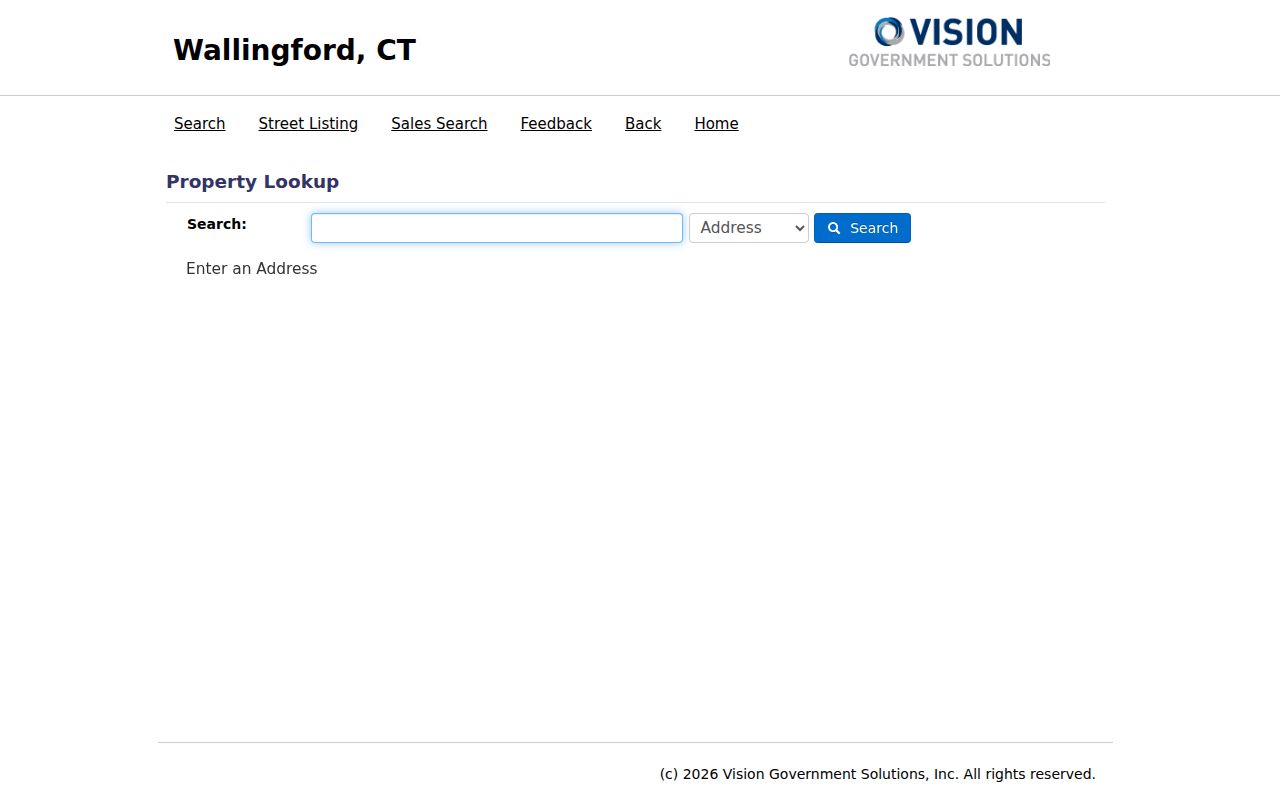
These fields identify ownership and tax-mail relationships, not every resident at the address.
Wallingford Deeds Connect Names
The Town Clerk is the local recorder. Wallingford Recordhub links grantors and grantees with document types, dates, and book/page references. A grantor transfers an interest; a grantee receives one. Mortgages, releases, liens, maps, and surveys can add names or explain why someone is tied to a parcel.
Index coverage begins January 17, 1963, while images begin January 20, 1963. Maps and surveys reach November 1, 1871. Older records require books, microfilm, or clerk help. A town attachment says Cott indexing and Adkins microfilming began in 1984. The three-day index and image difference is real, not an error.
Work backward from a current Vision owner. Search that name as a grantee, open the deed reference, then note the grantor and prior book/page cited in the legal description or return clause. Repeat with the earlier grantor. Recordhub's historical search help requires a login, a plan, and selection of the Wallingford search site. Index access and image printing are separate services, so save book/page citations even when the image is unavailable online.
The deed record may identify title parties without naming other members of a household. Mortgages can add borrowers and lenders. Releases explain when an obligation ended. Maps and surveys can preserve old lot numbers, while easements may use a neighboring parcel or borough name. Copies from an index are useful for research, but a certified copy must come from the custodian. For an instrument before the online range, take the last known book/page to Room 108 and continue in the bound or filmed index.
The Town Clerk page gives the current local access route.
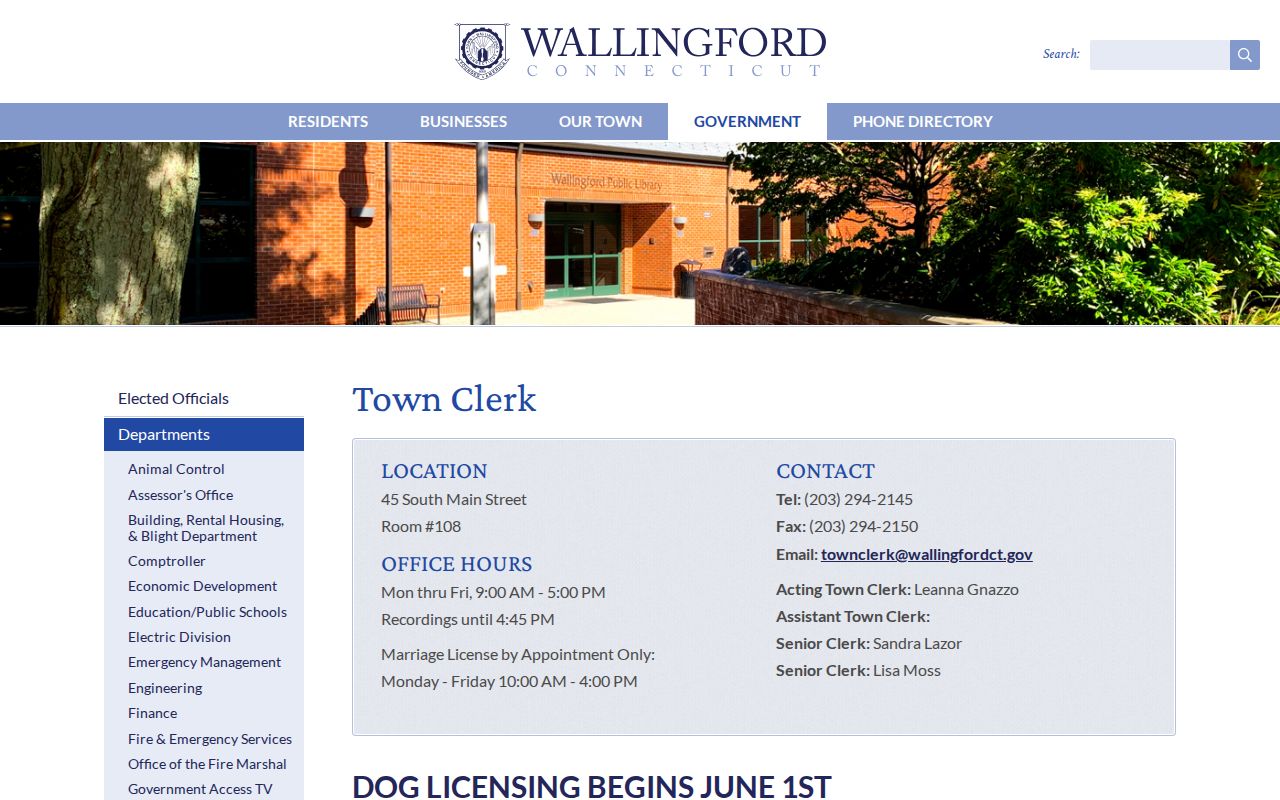
Confirm hours, copy methods, and charges there before ordering.
The Recordhub landing screen separates index access from image plans.
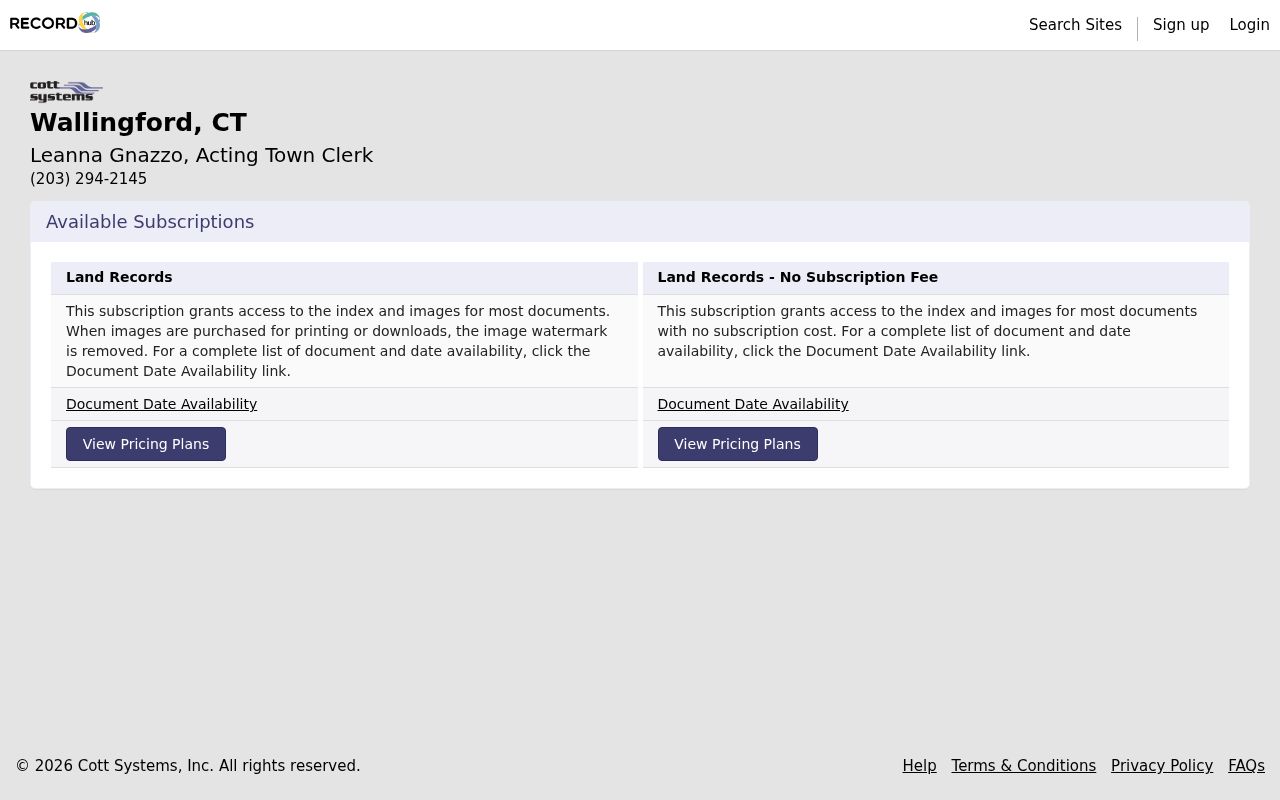
A free index result is a lead. Images and certified copies follow separate access paths.
Current Wallingford Directory Sources
Current resident rolls answer different questions and update on different schedules. Compare the record date and relationship shown before treating two matching names as one person.
| Source | Who It Lists | Keeper | Access |
|---|---|---|---|
| Property roll | Owners and tax addressees | Wallingford Assessor | Free Vision portal and office |
| Voter lookup | Individual registration | SOTS and local registrar | Free individual search |
| Land index | Parties to recorded instruments | Wallingford Town Clerk | Online index and clerk records |
| Civil court index | Named parties in displayed cases | Connecticut Judicial Branch | Free public inquiry |
| Town phone directory | Departments and public contacts | Town of Wallingford | Free online |
Commercial people-finder data may blend old sources without showing dates. Official rolls are narrower, but identify the custodian and the meaning of a field. Use the Wallingford resident lookup method when one name needs careful confirmation.
Other official sources fill special gaps. Connecticut Probate Court offers a case lookup, and Wallingford Probate handles local estates and related matters. State unclaimed-property search can connect a name with a reported address or holder, but the listing is a claim lead rather than proof of residence. The municipal phone directory identifies town departments and public staff contacts. Wallingford Center, the Historical Society, the library, and preservation groups provide community context, but research found no complete public neighborhood-association roster.
Dates make comparisons honest. The assessment roll follows a Grand List and revaluation cycle. The voter list changes through local updates, DMV notices, postal address checks, and inactive-list work. Court displays follow filing, disposition, erasure, and retention rules. A deed remains a recorded historical instrument even after ownership changes. Copy the date that belongs to the field, not merely the day you viewed the page.
There is no Wallingford or New Haven County jail roster because Connecticut has no county jail system. State incarceration questions go to Connecticut DOC, whose public search has its own identity fields and limits. The state offender registry is also a purpose-built public-safety record, not a general resident roll. Its warnings and identity controls must be read before using a result. Absence from either tool proves only that the displayed database returned no matching public entry.
Wallingford Voter Records Have Limits
The Connecticut voter lookup is for an individual registration check. Wallingford's registrar maintains local information while the Secretary of the State hosts the central tool. The public voter file is not the full application. Current rules protect sensitive identifiers and treat year of birth, rather than a complete birth date, as the relevant public file field.
A statewide data file requires a formal request, a stated use, and a current $300 charge. Connecticut also has a voter privacy program under CGS §9-50d. In January 2026, the Secretary of the State explained why it would not release full birth dates, driver-license data, and Social Security numbers sought in federal litigation. Use current guidance, not an old description of the roll.
The individual tool can confirm registration and polling information when the required personal inputs match. A bulk voter file is a different product with its own request form, fields, certification, and limits. The local registrar also keeps district lists and election records that may be inspected or requested if public. Historical voter statistics are safer for studying change than assuming a missing current result means a person never lived in Wallingford.
The official voter search form shows the public route.
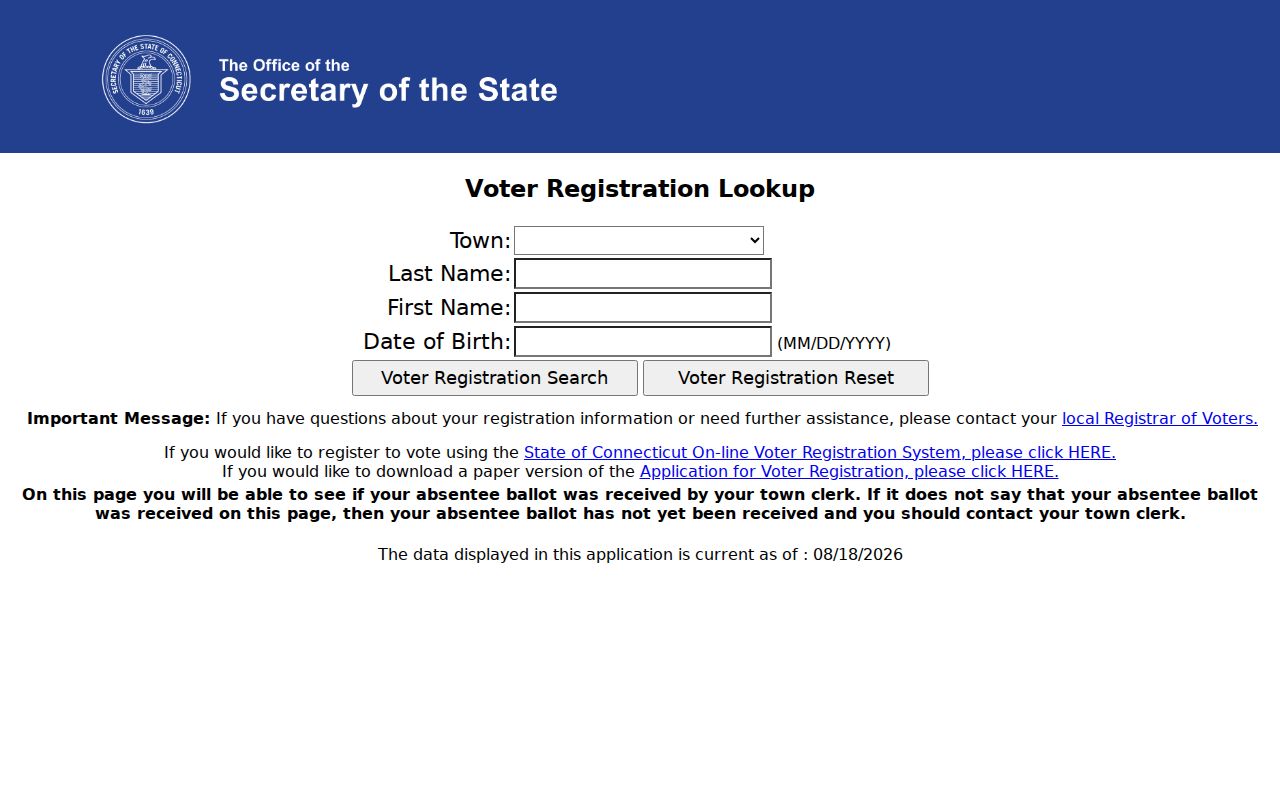
A match supports registration at a point in time. It does not list all people in a home.
Check Wallingford Court Name Trails
Wallingford matters route locally through Meriden's Judicial District and Geographical Area 7, but the Connecticut civil party search works statewide. It covers displayed civil, family, small-claims, and foreclosure matters. Separate forms accept a docket number or foreclosure property address. Pending criminal and motor-vehicle dockets use another Judicial Branch search.
Results may show a docket number, case name, court, case type, parties, attorneys, activity, documents, dates, or disposition. A docket is the court's case identifier and event record. A charge is not a conviction, and a name match is not an identity match. Compare town, case type, date clues, and status. Erasure rules and display policies can also make a matter absent from the public screen.
The civil party form supports party type and status controls as well as name searching. The docket form is stronger when another record supplies the exact identifier. The property-address form is limited to its stated foreclosure search purpose, not a general address directory. Paper files and documents that are not shown online may be available through the responsible clerk, subject to sealing, redaction, copy charges, and court rules. Federal cases use the District of Connecticut and PACER rather than the state inquiry.
Probate provides a separate name trail for estates, trusts, guardianship, and other matters within its public display rules. When looking for an heir, identify the correct probate district, case number, and decedent before asking for a file. Do not use a similar surname as proof of family. A death certificate, obituary, directory address, deed, and probate filing can support one another when their dates and identities align.
The Judicial Branch screen illustrates the official name-search route.
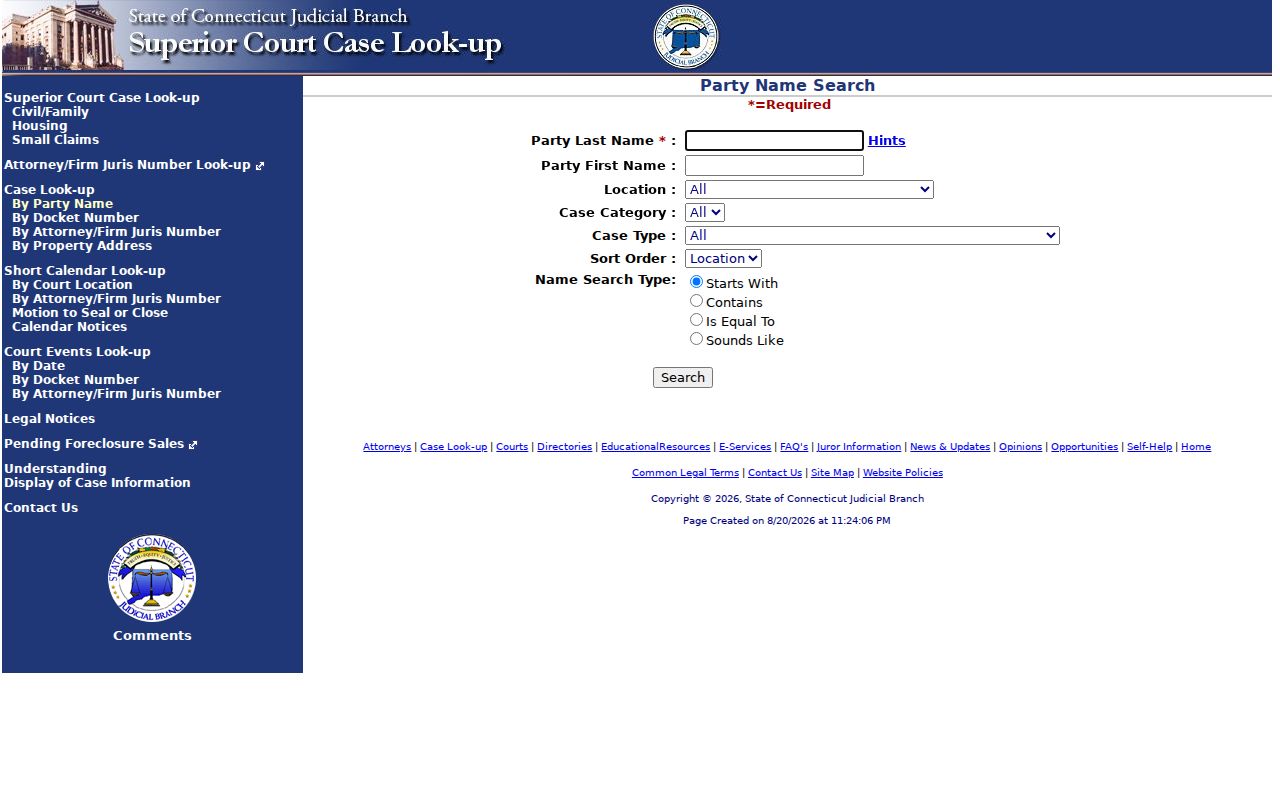
Use the court index to verify a case, never to infer a present address from a name alone.
Vital Records Use Different Doors
Wallingford Town Clerk can issue local certified copies, while the Connecticut Office of Vital Records supplies statewide routes and special forms. Birth records under 100 years are restricted by CGS §7-51. Marriage and death copies are generally available to an eligible applicant age 18 or older, subject to identification and application rules. Adoption and foreign-birth records have distinct protected routes.
Choose the office by event, year, and eligibility. State forms ask for the named person, event facts, requester's identity, relationship, purpose, mailing details, and proof of identity. A certified copy carries the custodian's certification. A search result or index entry does not.
Connecticut DPH documents online, mail, and walk-in routes. A local event may be easier through the Wallingford Town Clerk, while a statewide search, older record, adoption matter, or foreign-birth question may need the state office. Form instructions govern acceptable identification, proof of relationship, payment, and processing. Do not send sensitive documents to an address copied from an unofficial directory.
Genealogy access broadens for older material, yet researchers still must follow the statute and the repository's handling rules. Divorce is a court record rather than a town vital certificate. Annual state vital-statistics reports beginning in 1992 provide aggregate counts, not named resident rolls. For birth-parent contact, Connecticut's official adoption reunion and search programs preserve confidentiality and are the proper path.
The state application hub provides current forms.
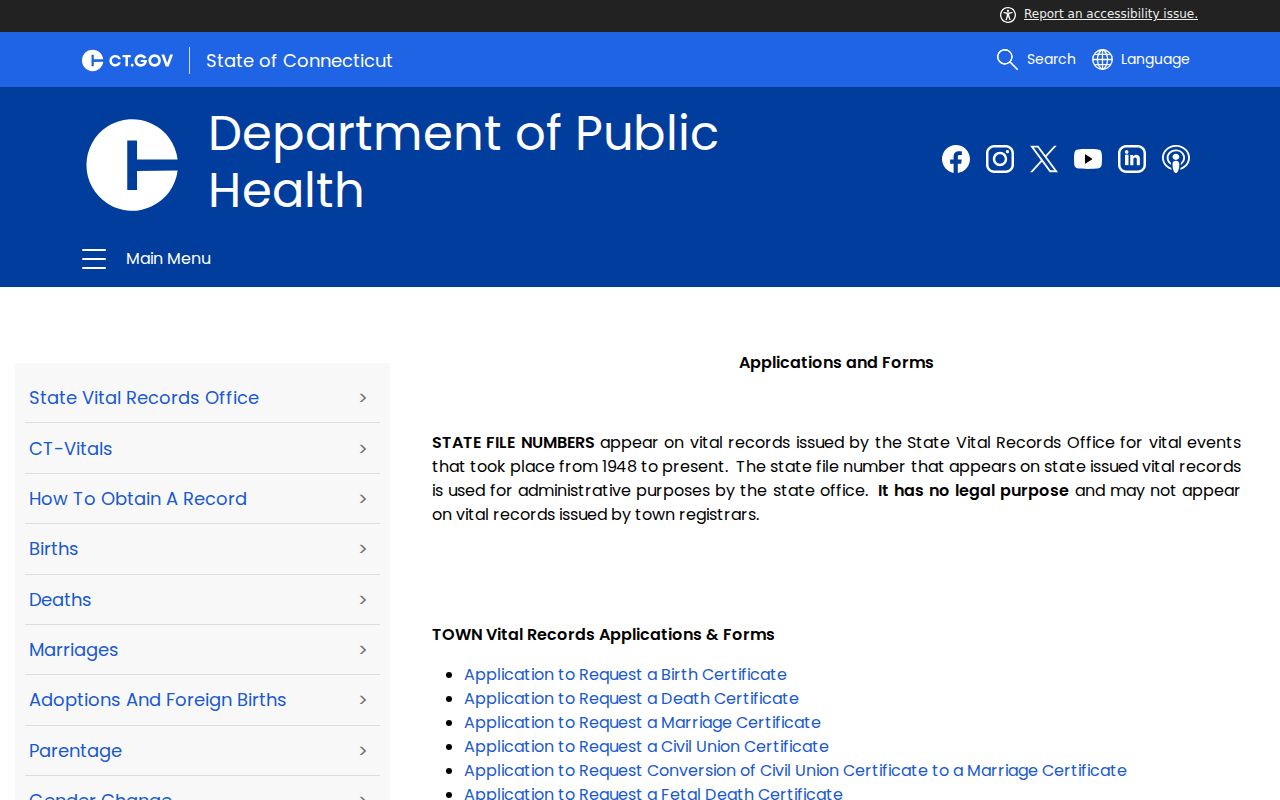
Read the eligibility notes before sending identification or payment.
Wallingford Licenses Confirm Roles
A name may appear because of a professional or business role. The Connecticut eLicense search covers more than 800 credential types and may show a license number, type, status, issue or expiration details, and board. The Connecticut Business Registry searches entities, principals, agents, addresses, and filings. Local trade names remain with the Town Clerk.
These role records do not prove residence. They can distinguish people who share a name or connect a directory abbreviation with an occupation. Keep the entity or credential identifier and result date so another researcher can repeat the check.
Search eLicense by credential type, name, number, city, or other displayed controls, then read the issuing board and status. For a business, start with the legal entity name or business ID and download the state result when available. The business address might be a registered office, agent address, principal office, or mailing point. A Wallingford trade-name filing can lead back to the Town Clerk when a shop used a name different from its owner's name.
Use names carefully. Try initials, former names, and spelling variants, then confirm a second official field before joining two records.
Explore Historical Wallingford Directories
Wallingford Public Library's digitized city directory runs cover 1883 through 2000 with gaps. The collection reports 17,738 pages for 1883–1976 and 5,283 pages for 1978–2000. A 1931 Price & Lee volume has governmental, buyers, alphabetical, numerical, and classified parts. One book can answer several types of question.
OCR is only a first pass. Old type, initials, spouse-in-parentheses forms, and abbreviations cause missed matches. Browse nearby pages and check a surname in both the alphabetical and numerical street sections. Census schedules, newspapers, deeds, and maps can then confirm a household. The complete shelf method appears in the Wallingford city directory collections.
The Wallingford Public Library Connecticut Collection is closed stack. Staff retrieve items, use is supervised, and the material stays in the building. Researchers may use pencils or personal computers, while copying depends on condition and copyright. The Bridgeport History Center and Connecticut State Library can help fill year gaps. Federal census schedules become public after 72 years, so the 1950 census is open while later individual schedules remain closed.
Newspapers add dates, relatives, clubs, businesses, and life events that a directory compresses into one line. WPL provides local newspaper and licensed database access, but the research did not verify a separate public Wallingford obituary card index. Ask library staff about newspaper coverage instead of promising a database that may not exist. Center Street Cemetery holds early local context, yet no public interment-name search was confirmed. A death record, obituary, cemetery inquiry, and probate case should remain separate sources until their details agree.
Follow one address across adjacent directory years before drawing a conclusion. A person may disappear because of death, a move, military service, a publisher omission, a spelling change, or an OCR error. Pair the numerical street section with alphabetical entries. Then compare deeds for ownership, a Sanborn map for building use, and newspapers for dated events. Directory page counts describe the scale of the collection, not the number of unique Wallingford residents.
Wallingford Record Terms Decoded
Four labels make the residents directory easier to read and keep unlike records from being confused.
- Roll
- A list kept for a defined purpose, such as assessment or voter registration.
- Index
- A finding aid that points to a record, but is not always the full image.
- Parcel
- A mapped piece of land identified for assessment and land records.
- Criss-cross directory
- A directory arranged by street and number instead of only by surname.
The Parsons House is a useful local example. Sources describe it as a tavern and stage stop, private house, deed-chain property, place tied to a probate judge and town clerk, and Historical Society museum. Each label belongs to a source and time. None should become a claim about a current resident.
Privacy Shapes Wallingford Lookups
Connecticut's Freedom of Information Act, CGS §§1-200 through 1-242, opens many government records but preserves exemptions. Safe at Home gives eligible participants a substitute address. Voter privacy rules, protected recent births, adoption files, DMV limits, court erasure, and agency redactions narrow what a public directory may display.
The Connecticut Data Privacy Act supplies rights for some data held by covered businesses, but government records follow their own statutes. A private opt-out cannot erase a deed. Ask the custodian about correction, redaction, confidentiality, or appeal paths for that record.
FOIA requests should describe an existing record with enough detail to locate it. Agencies must respond promptly under the circumstances, but may charge lawful copy or scanning fees and withhold exempt content. An index can remain visible even when the underlying image has protected details. If access is denied, ask for the legal basis and use the Freedom of Information Commission's guidance on clarification or appeal.
Commercial deletion requests follow another track. The Attorney General explains Connecticut consumer privacy rights and complaint channels, while each covered service supplies its own request method. Public agencies may correct a factual error but retain the record as law requires. Safety concerns deserve direct action: use Safe at Home for eligible address protection, contact the agency that displays the field, preserve evidence of misuse, and call police when conduct becomes threatening.
Lawful personal use only. Never use resident records to stalk, harass, threaten, or harm anyone; confirm uncertain details with the custodian.
Main Street Links Wallingford Records
Wallingford's first homes clustered along present Main Street after six-acre lots were laid out. The corridor now joins Town Hall, the library, railroad station, Center Street Cemetery, and landmark buildings. It gives old maps and current records a shared frame, but source labels still matter.
Town Hall was built as a high school in 1916 and rededicated for town use in 1988. Its parcel card is a clean lesson: a valid address may represent a civic building, not a household. The station dates to 1871. The Historical Society lists maps from 1670, 1856, 1868, and 1881 plus Sanborn sheets for 1885, 1892, and 1897. Those landmarks can bridge a deed, directory, and map without inventing a resident link.
Older documents may name the Borough of Wallingford. The borough and town consolidated in 1958, yet borough wording survives in deed references. Search both municipal names. That quirk can rescue a missed record and shows why the Wallingford residents directory works best as a chain of dated sources.
The 1931 Price & Lee directory reflects Wallingford's silver and manufacturing history through business classifications and occupations. A Hall Avenue entry may sit near industrial material rather than describe a simple home. The Yalesville Underpass, old route names, and village labels can also shift the words used for a place. Preserve the wording from the original source, then translate it cautiously to a modern parcel or street.
Wallingford's map record adds another safeguard. The Historical Society's 1885, 1892, and 1897 Sanborn sheets can show whether a site was a home, shop, mill, or mixed-use building. Modern tax maps may mark a lot on another sheet, and GIS edit fields can flag a split parcel, combined parcel, or lot-number change. If an old address refuses to match, compare the directory's street order, deed description, map landmark, and present parcel shape. The mismatch may reflect a changed record identity rather than a missing resident.
Keep citations as the chain grows. For a portal, save the keeper, search field, result date, and stable record identifier. For a book, note title, year, page, and section. For a deed, record grantor, grantee, instrument type, recording date, and book/page. For a court case, retain the docket and status date. These details let another person retrace the Wallingford residents directory search without relying on a screenshot or an unsupported conclusion.
Note: Portal coverage changes, so recheck the custodian screen before relying on dates, fees, or an online result.