
Wallingford Resident Lookup Sources
One name can describe several relationships in Wallingford records. An assessment identifies a tax owner. A deed names parties to a transfer. A voter entry concerns registration, and a docket identifies a party in a court matter. Start with the source that answers the exact question, then check an independent source with a compatible date and role.
| Record | What It Confirms | Where | Access |
|---|---|---|---|
| Assessment parcel | Owner, situs, mailing address, PID, sales clues | Vision Government Solutions | Free online |
| Voter registration | Registration fields allowed by current law | SOTS or Wallingford Registrar | Individual lookup; file restricted |
| Court case | Party role, docket, court, filing, disposition | Connecticut Judicial Branch | Free index; clerk copies |
| Vital record | A qualifying birth, marriage, or death event | Town Clerk or DPH | Eligibility and fees apply |
| Credential or entity | License status or a filed business role | eLicense or SOTS Registry | Free current search |
If an address is known, the Wallingford Vision database is a useful anchor. If only a name is known, begin with the state court party search. Each result is dated evidence, not a full resident profile.
Search Wallingford Court Names
The Connecticut civil party-name search accepts a required last name and optional first name. Location, category, case type, and sort order can narrow results. Name modes include Starts With, Contains, Is Equal To, and Sounds Like. Search statewide first, since a Wallingford resident may have a matter outside Meriden. Then test Meriden or GA 7 when local court geography matters.
| Control | Use |
|---|---|
| Party Last Name | Required; partial first letters accepted |
| Party First Name | Optional; useful after a broad surname pass |
| Location | Optional; includes Meriden and GA 7 |
| Category and Type | Optional choices depend on the current portal |
| Name Search Type | Starts With, Contains, Is Equal To, Sounds Like |
Apostrophes, initials, former names, and spelling variants can split one person across results. A hit may belong to a business, fiduciary, attorney, or organization. The index is a lead, not the case file and not proof of an allegation.
The captured civil docket-number form shows how a known docket can be rebuilt from location, category, year, number, and suffix.
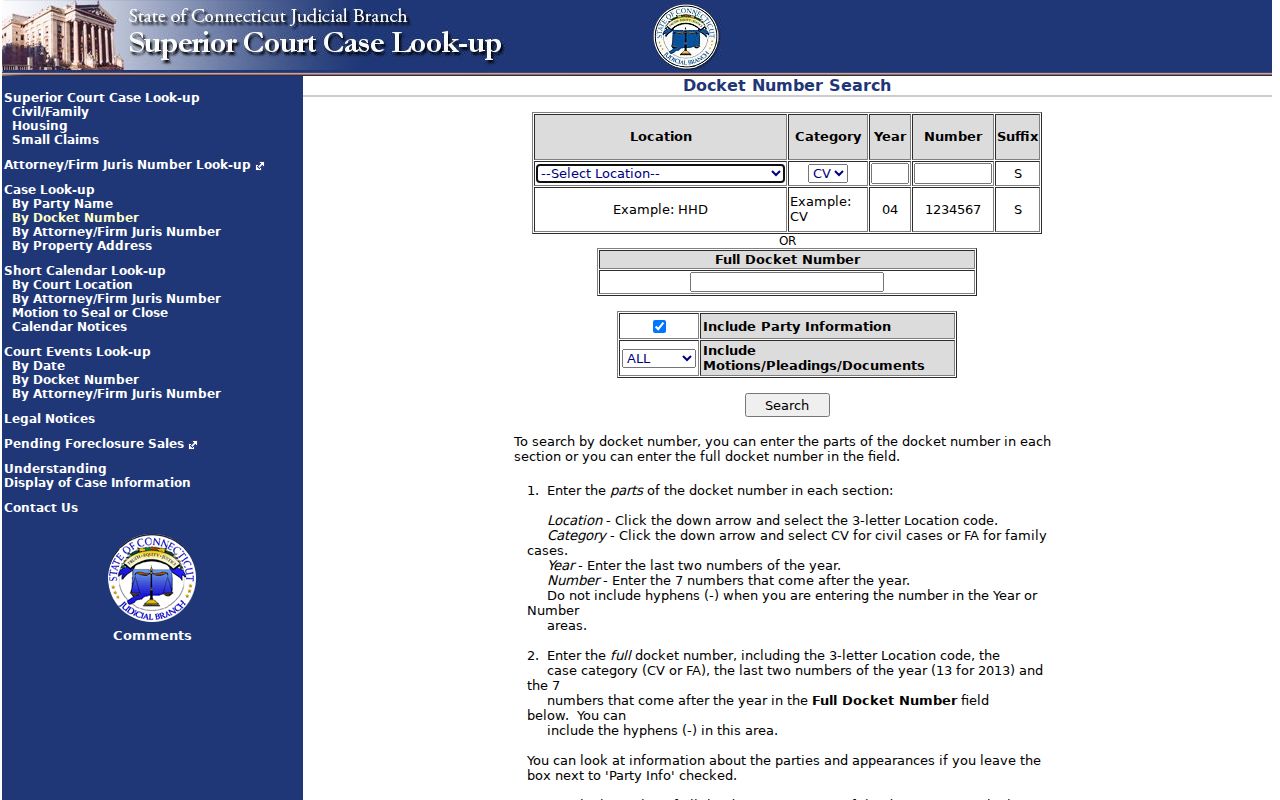
Use this precise route when a notice, news report, or probate paper already supplies the docket number.
Read Wallingford Docket Results
A civil result can show the case name and type, docket number, file and return dates, court location, last action, disposition, parties, appearances, motions, documents, and scheduled events. Keep those fields separate. A scheduled date is not a disposition, and a filed motion is not a ruling. The Judicial Branch updates entries as they are made, while scheduled events update nightly.
Display windows vary by category. Many civil, family, and small-claims matters remain visible for limited periods after disposition. Juvenile, erased, protected, and confidential matters may never appear. No result cannot prove that no case exists.
- Docket
- The court's identifying number and running record for one case.
- Index
- A searchable pointer that may omit the filed document image.
- Certified copy
- A custodian-issued copy authenticated for formal use.
- Disposition
- The recorded resolution or status, not merely a claim.
Verify Wallingford Resident Records
A defensible match rests on two independent records with dates that can coexist. Pair a parcel with its deed, a directory address with an obituary, or a docket party with a public business filing. Do not force a match through a full birth date, protected voter address, or other sensitive identifier.
- Normalize the name. List initials, punctuation, former names, and plausible spelling variants.
- Anchor it to a public date and place through Vision or the court party portal.
- Check a separate official source, such as a voter record, deed, credential, probate case, or directory.
- Compare role and chronology. Owner, voter, litigant, principal, and licensee are different ties.
- Save the query date and custodian. Ask that office for correction or a certified copy.
For a whole road rather than one person, the Wallingford street records page follows the address-based chain.
Confirm Wallingford Voter Context
The Connecticut voter lookup is statewide, while Wallingford's Registrar maintains the local list. Public information can include a name, bona fide residence, district, party, registration details, and election participation fields, subject to current limits. Only the year of birth is public under the current state rule.
A voter entry proves registration at a point in time. It does not prove ownership, continuous occupancy, or physical presence today. The statewide file is not an open resident directory: its written request costs $300, arrives as CSV, and requires a permitted-use attestation. CGS §9-50d also supports voter-registry privacy when disclosure would endanger a voter or family.
Note: The Wallingford Registrar, not a county office, is the correct local contact for list maintenance and dated voter questions.
Wallingford Vital Record Checks
Vital records confirm a life event or relationship when the requester qualifies. They are not a public current-resident roll. The Connecticut DPH vital-records hub covers statewide registries from July 1, 1897 forward, while each town keeps local records. A Wallingford event often moves faster through the Town Clerk. Older events belong first with the town where they occurred.
Birth certificates less than 100 years old are restricted under CGS §7-51. Marriage and death copies are more broadly available to eligible adults, but protected fields remain limited. Town and state forms ask for the event, requester identity, relationship, reason, signature, copy type, and payment. A public index is a lead. A certified copy is the controlled record.
One missing town birth result does not settle the question. Pre-statewide custody, residence rules, adoption sealing, and record transfers can all create a gap.
Check Wallingford Names by Role
The Connecticut eLicense search is a real-time primary source for more than 800 credential types. Search fields include credential type, number, status, business name, first and last name, address, city, state, ZIP, and country. Results may show the licensee, credential, issue and expiration dates, status, basis, and discipline. A credential confirms a regulated role, not residence.
The Connecticut Business Registry accepts a business name, ALEI, or filing number. Results can identify the business, principal, agent, formation date, entity type, address, and annual reports. Wallingford Town Clerk trade names add a local layer. Search one surname across all three, but preserve each displayed role and filing date instead of merging names.
This comparison is a useful insider method. A name may appear as a trade-name filer, entity agent, and credential holder at different dates, yet none alone establishes residence.
Wallingford Family Search Paths
An heir or fiduciary trail should begin with the Connecticut Probate case lookup, followed by the district clerk or file. Case type, status, and a stated fiduciary role carry more weight than a surname match. Some filings remain restricted. For a former classmate, Wallingford Public Library yearbooks, digitized directories, and newspaper archives offer dated ties without claiming a current address.
Birth-parent and adopted-relative searches use the DCF Search Unit and Reunion Registry, not a public name tool. Adoptions since 1944 route to DCF, while older inquiries go to the Probate Court involved. Agency forms support consent-aware reunion and non-identifying information. This human process protects both parties.
Request Missing Wallingford Records
When no portal answers the question, contact the office that keeps the record. Connecticut's Freedom of Information Act, CGS §§1-200 through 1-242, provides the general route for existing public agency records. Describe the record, date range, subject, and preferred format. The agency may redact exempt fields or explain that no responsive record exists.
The captured Connecticut FOI Commission guidance explains requests, prompt access, exemptions, fees, and appeals.
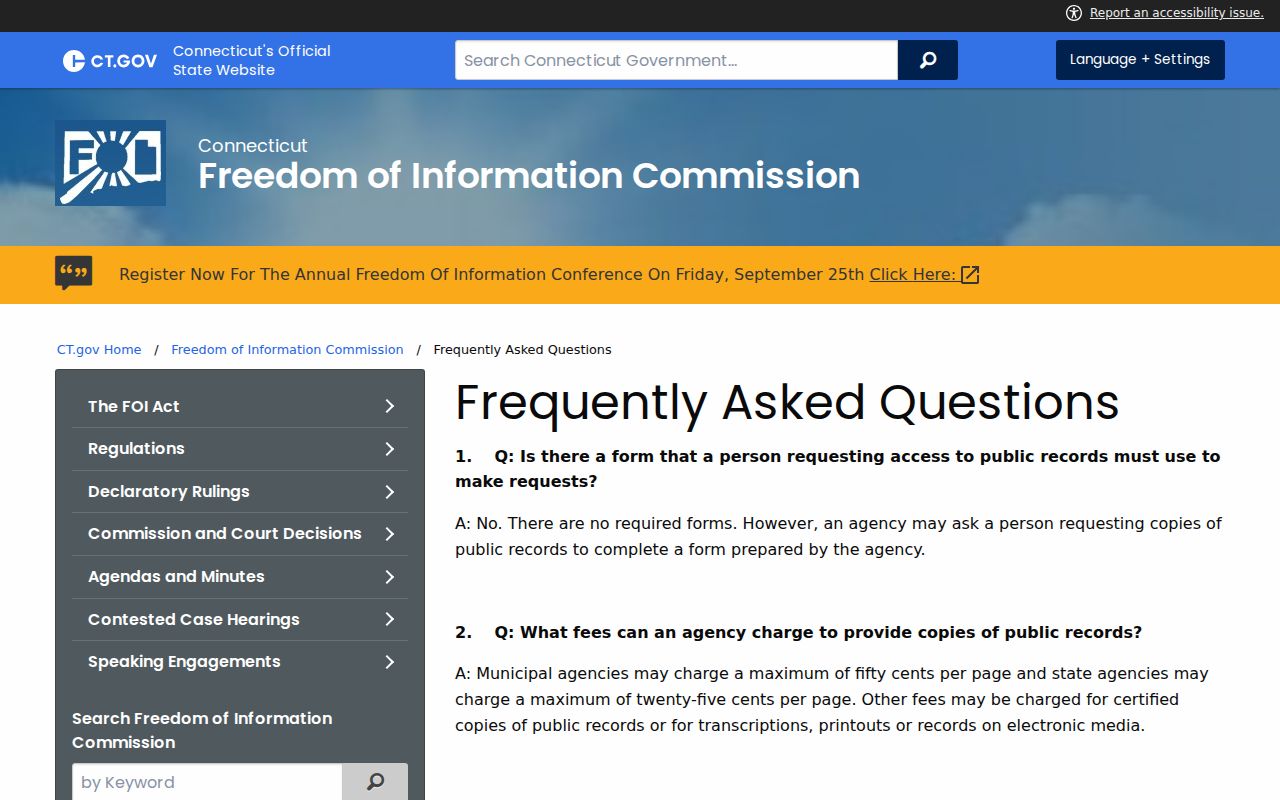
FOI is a fallback for agency records, not a way around vital, court, voter, or confidentiality statutes.
Wallingford Resident Lookup Limits
Public does not mean complete or unrestricted. Safe at Home can supply an eligible survivor with a substitute mailing address. Voter privacy can protect registry details. Birth, adoption, DMV, juvenile, erased, and sealed records follow separate law. An assessor mailing address may belong to an owner elsewhere, and a business filing may remain after a role changes.
A commercial people-finder profile may blend public data, purchased material, and inferred links. Treat that category only as an unverified lead. Corrections belong with the custodian: Assessor for parcels, Registrar for voter data, court clerk for dockets, DPH or Town Clerk for vital records, DCP for credentials, and SOTS for entities.
Lawful use. Use a Wallingford resident lookup for lawful personal research. Never use public details to stalk, harass, threaten, or harm anyone.
The useful result is a dated source trail that states what each record proves and cannot prove. That limit protects accuracy and privacy.
Keep a simple research log for every serious search. Record the exact name entered, the match mode, filters, date searched, result URL, and the office responsible for the data. Note whether the item is current, historical, an index entry, an image, or a lead awaiting a copy. If two sources disagree, do not choose the more convenient answer. Compare their effective dates and ask the custodian how updates reach the public system. Wallingford property data, Connecticut court entries, voter fields, and license records follow different update cycles. A conflict may reflect time rather than error. This habit also makes it easier to correct a wrong record without spreading the mistake into another file.