
Wallingford Directory Years and Shelves
Wallingford city directories survive through a large free digital run and several physical collections. The online viewer divides the run into two publication groups. It lists individual issues, not one continuous annual series, so a missing year must be treated as a gap rather than proof that a person left town. Wallingford Public Library keeps additional town directories in its supervised Connecticut Collection, while the Bridgeport History Center lists many Wallingford volumes that can help fill gaps.
| Collection | Years | Keeper | Access |
|---|---|---|---|
| Wallingford City Directories | 1883-1976, selected issues | Advantage Preservation | Free search, browse, and page images |
| Wallingford City Directory | 1978-2000, selected issues | Advantage Preservation | Free online viewer |
| Town directories and local files | Collection varies | Wallingford Public Library | Closed stack, staff retrieval |
| Wallingford directory holdings | 1929-1991, selected issues | Bridgeport History Center | Physical holding; confirm before visiting |
The visible online years begin with 1883 and 1889, continue at uneven intervals through the early twentieth century, and become more frequent in later decades. Publication ends at 2000 in the located digital collection. Always cite the exact issue and page.
The decade index makes the gaps plain. Visible issues include 1891, 1893, 1895, 1897, and 1899; selected issues from 1903 through 1929; and fourteen issues from 1930 through 1957. Later coverage includes issues from 1964 through 1976, then a broad but still incomplete run from 1978 through 2000. The Wallingford city directory archive should therefore be searched on both sides of a missing year. A move between two listed addresses may have happened at any point in that interval.
Search Wallingford Directories Online
The digitized Wallingford directory collection offers keyword, plus-term, and minus-term boxes. A search can require all words, an exact phrase, any words, or exclude words. Date fields accept a start and end date, and browsing can be narrowed by publication, year, or decade. Results provide an OCR snippet, issue date, publication identifier, and page-view link.
OCR means optical character recognition, the machine-made text extracted from a scanned page. It is useful for finding a likely page, but old type, tight columns, and worn paper can turn names and streets into false spellings. Search a surname alone, then a street, house number, initials, and likely spelling variants. Open the image before copying an entry.
The collection holds 17,738 scanned pages for 1883-1976 and another 5,283 for 1978-2000. Those counts show the size of the archive, not a count of people. The 1970s alone account for 4,783 visible pages.
Use the viewer controls with care. An exact-phrase search is useful for a full street name, while an any-words search can recover a line split across columns. A minus term can remove a common business result. Ten-result paging means the first screen is not the whole result set. When a useful hit appears, note the publication group as well as the printed year because the archive uses separate identifiers for the earlier and later runs.
The 1931 Wallingford Directory
The 1931 Price & Lee volume is especially useful because its title page describes five directories in one book: governmental, buyers, alphabetical, numerical, and classified. The alphabetical portion brings names, trades, and addresses together. The numerical portion reverses the route, placing streets and house numbers first. Classified pages group firms and professions, while governmental pages identify public offices.
See the 1931 directory title and contents in the original viewer.
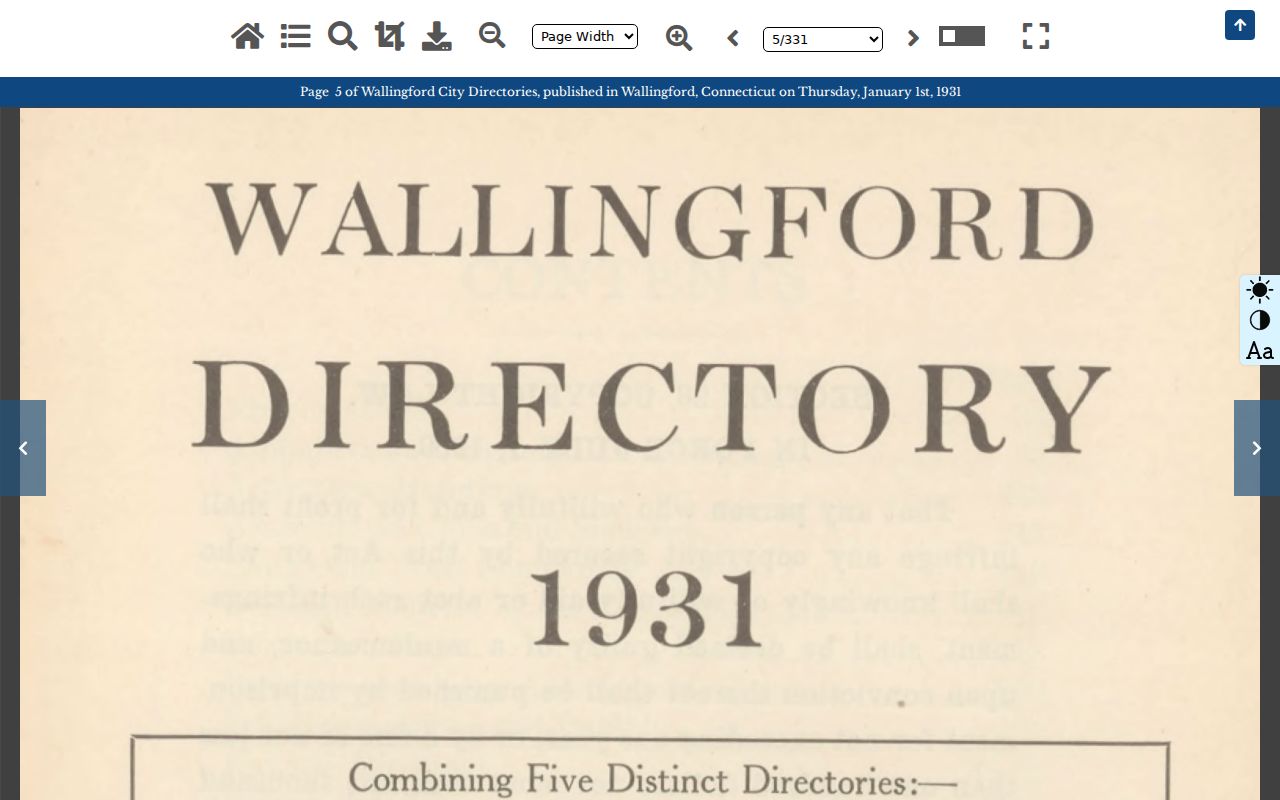
The captured contents make the five-part design visible and show why both name-order and street-order searches belong in a sound historical check.
Decode a Wallingford Directory Entry
A city directory entry can combine several facts in one narrow line. The exact format changes by issue, so the key or abbreviation page should be saved with the result. The 1889 samples include names, trades or employer phrases, boarding notes, and street addresses. The 1953 results can show a spouse in parentheses, a firm, a rural-route or street address, and a household address.
| Name | Surname, given name, initials, or a married-name form as printed |
|---|---|
| Work clue | Occupation, trade, employer, or business affiliation |
| Household clue | Spouse notation, boarder marker, or other status abbreviation |
| Address | House number, street, rural route, or business address |
| Source | Issue year, page, section, and viewer URL needed for verification |
- Criss-cross directory
- A street-first or telephone-first section used to work backward from a place.
- Householder index
- A list organized around the person associated with a household.
- Abbreviation key
- The issue's own guide to short forms, symbols, occupations, and status marks.
Read all neighboring lines before isolating a result. Dense columns can cause OCR to join one person's surname to another person's address. A spouse in parentheses is a printed relationship claim, not a modern identity record. Likewise, a business address may differ from the residence in the same entry. Photograph or save enough of the page to retain column headings, nearby street labels, and the printed key.
Wallingford Library History Access
The Wallingford Public Library Connecticut Collection is at 200 North Main Street and can be reached at 203-265-6754. It is closed stack. Staff retrieve requested items, supervise use, and keep materials in the building. Researchers may use pencils or personal computers; careful reproduction is subject to copyright and credit rules.
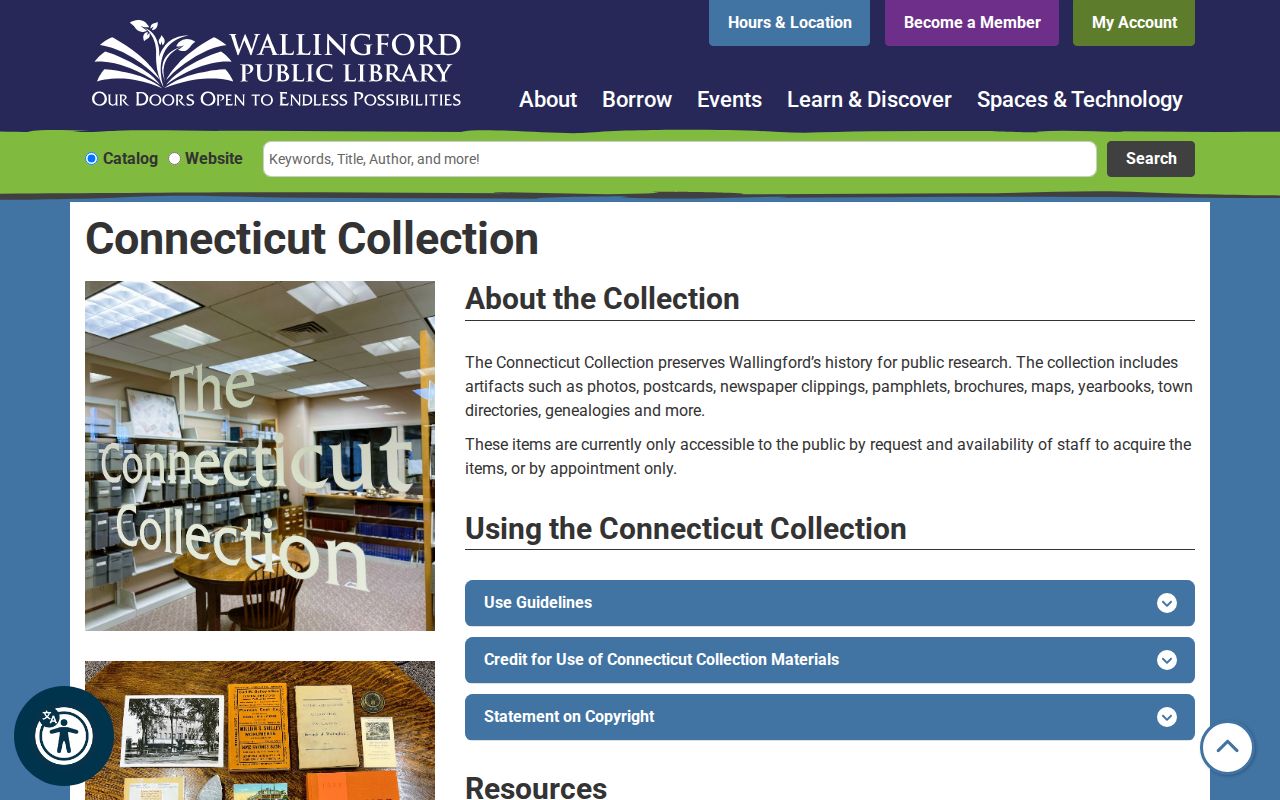
The collection page confirms that directories sit beside photographs, postcards, maps, clippings, pamphlets, yearbooks, and genealogies. Posted hours are Monday through Thursday 9:30 a.m. to 9 p.m., Friday to 6 p.m., and Saturday to 1 p.m.; Sunday is closed. Call ahead for staff retrieval or an appointment.
Extend Wallingford Directory Clues
A name that disappears between city directories needs a second source. Library newspaper tools cover the Journal from 1886-1977, the Meriden Daily Republican from 1868-1898, the Meriden Weekly Republican from 1892-1917, and the Record-Journal from 1892-2022, with a 30-day embargo in that database. Full-text Record-Journal access also reaches from 1997 to the present.
No standalone public Wallingford obituary index was located. Search the newspaper layers, then ask Connecticut Collection staff about clippings, local genealogies, or related files. An obituary can suggest relatives and dates, but each statement still needs its own source. Yearbooks can distinguish classmates with similar names; maps can show a site whose street label changed.
Library access also includes Ancestry Library Edition inside the building. Its census, military, probate, land, vital, church, passenger, and directory material can extend a Wallingford city directory clue, but database access does not remove the rules attached to a certificate or archive. The Connecticut State Library and Archives, Godfrey Library, C.H. Booth Library, Connecticut Digital Archive, Historical Society, and Connecticut Society of Genealogists offer other routes. Confirm a specific collection before traveling.
Trace Wallingford Families by Directory
Use each directory issue as a dated snapshot. A listing means the publisher associated a name with that entry in that year. It does not establish deed ownership, voter status, or presence for every month. Pairing independent records reduces mistaken identity and shows when an address change is real.
- Find the earliest clear name or address entry and save its issue, page, and section.
- Move forward issue by issue, noting gaps, spouse forms, trades, and each street change.
- Check the numerical section to see who else was printed at the address or nearby.
- Pair public federal census years, including 1950, with surrounding directory issues.
- Use newspapers, probate, vital records when eligible, land records, and maps to explain the change.
If a name vanishes, test a move, death, marriage-name change, omitted listing, OCR error, and a missing issue before drawing a conclusion. For modern address-keyed ownership, use the Wallingford street directory workflow rather than treating an old listing as current.
A clean research note distinguishes each relationship. “Listed at” reports what the directory printed. “Owned” requires an assessor or deed source. “Received mail” comes from a mailing field, and “appeared in the household” may come from a census schedule. Record uncertainty in plain words. This method is slower than copying an OCR snippet, but it prevents a similar name, business entry, or boarder notation from becoming an unsupported family claim.
Map Wallingford Directory Addresses
The Historical Society lists town maps from 1670, 1856, and 1868, an 1881 bird's-eye view, and Sanborn fire-insurance sheets for 1885, 1892, and 1897. These sources can place a directory address in its period and show whether a site served as a home, shop, mill, or mixed-use building. Do not force a current street number onto an older map that did not use it.
Industry terms offer another way into the classified pages. Wallingford sources mention pewter, Britannia ware, silver, rail transport, mills, and spoon manufacture. Search a company or trade when a name is common, then return to the alphabetical entry for the printed address.
Parsons House offers a useful source lesson. The building at 180 South Main Street has been described as a tavern and stage stop, a private house, property in a deed chain, and a Historical Society site. A later owner, Eli W. Ives, was a probate judge and town clerk. Each label answers a different question. The city directory entry, map, deed, and institutional history should remain distinct even when they describe the same place.