
Wallingford Address History Sources
The best starting source depends on the period. Wallingford land records reach far beyond the online portal, while city directories appear in an uneven run. Use the table as an era guide, not as proof that every year or household is present.
| Source | Years it covers | Where held | What it shows |
|---|---|---|---|
| Land-record index and images | Index from Jan. 17, 1963; images from Jan. 20, 1963 | Recordhub and Town Clerk | Owners, transfers, legal description, book/page |
| Maps and surveys | Online from Nov. 1, 1871 | Recordhub and Town Clerk | Lots, plats, easements, parcel clues |
| City directories | Issues from 1883 to 2000, with gaps | WPL digital collection | Householders and businesses by name or number |
| Federal census | 1790 through 1950 public under the 72-year rule | Archives and library databases | Enumerated household at a historical date |
| Property card | Current database with sale history | Vision and Assessor | PID, MBLU, owner, situs, mailing, sale links |
| Building/PZ files | File-specific | Wallingford departments | Project, applicant, approvals, changes |
Begin with Vision for a modern property, Recordhub for a post-1963 transfer, and the Town Clerk counter for earlier books. For occupancy rather than title, choose the closest directory or public census year. A gap in a digital run means “not found online,” not “no past residents.”
Lock the Wallingford Parcel
Search the Vision database by address and save the current property-card PDF. Record the physical or situs address separately from the owner mailing address. Copy the PID and MBLU exactly, along with the valuation year, latest sale, owner history, book/page, map reference, and building details. The database reflects the October 1, 2024 revaluation.
These identifiers keep a Wallingford address history attached to land when wording shifts. A mailing line may lead to a trust, business, estate, fiduciary, or another town. It does not prove that the owner occupied the house. Likewise, a building year is an assessor fact, not a list of the first household.
- PID
- The internal parcel identifier used by the assessment database.
- MBLU
- The map, block, lot, and unit code that links the property to assessment maps.
- Legal description
- The deed language that identifies land by bounds, lot, map, tract, or easement rather than only a street address.
Trace Wallingford Owners Backward
The Town Clerk at 45 South Main Street, Room 108 is Wallingford's recorder. New Haven County is only geographic here; Connecticut abolished county government in 1960. Use Recordhub for the available index and images, then use the counter for books before the online cutoff.
- Take the current owner, PID, MBLU, and legal description from Vision. Save the sale book and page.
- Find that purchase deed. Read the full instrument for the seller, map, restrictions, easements, prior deed references, and property description.
- Search the seller as a grantee to locate the deed by which that person or entity acquired the parcel.
- Repeat the link. Keep index date, recording date, book/page, grantor, grantee, and image status in separate fields.
- When a reference predates online coverage, continue at the Town Clerk counter through bound books or microfilm.
A grantor gives a property interest; a grantee receives it. The chain of title is the linked sequence of those transfers. Wallingford's no-subscription plan provides index viewing after account creation, while image access and printing use separate terms. Cott advertises $2 per printed page.
The Recordhub date-coverage screen shows the online boundary used for Wallingford previous residents research.
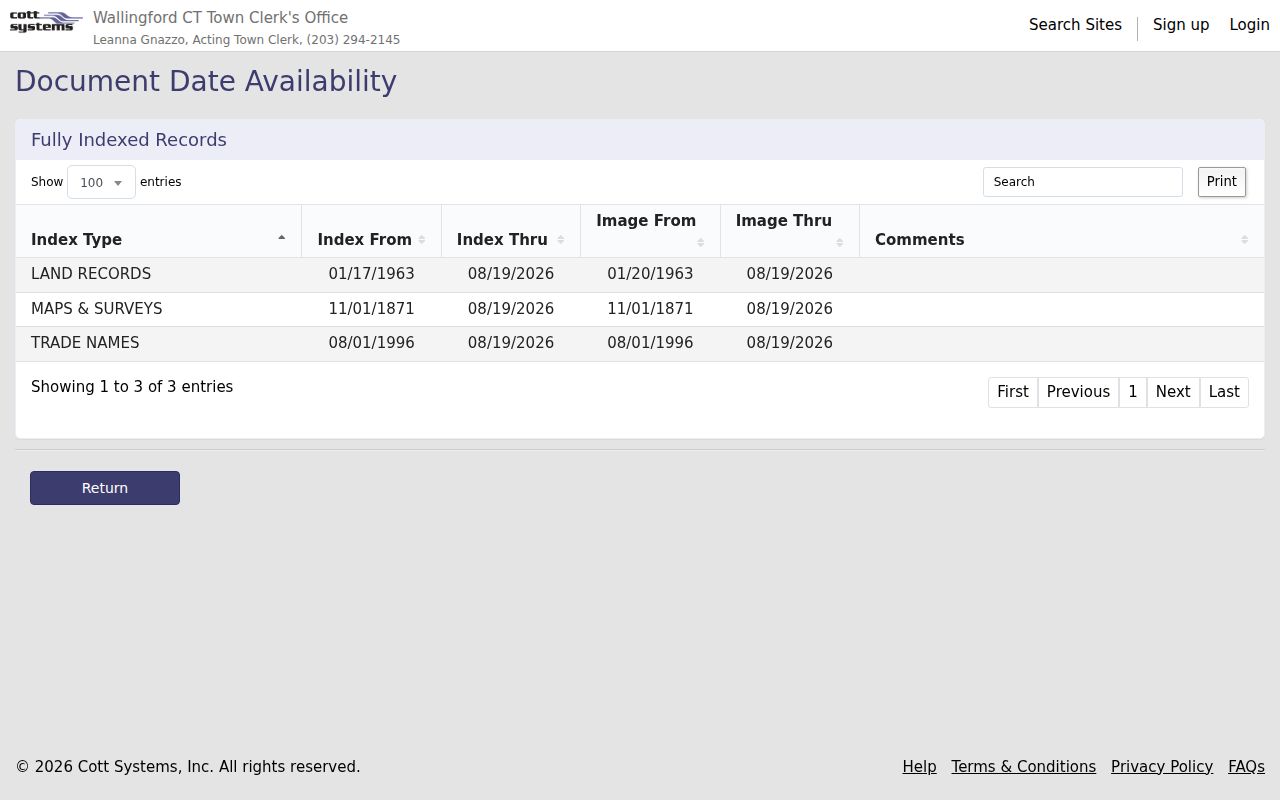
The screen confirms why a complete deed trail may shift from a web index to the clerk's older volumes. The three-day difference between land-index and image start dates must remain visible.
Wallingford's 1984 Records Shift
An official town attachment says Adkins Printers began microfilming Wallingford land records in 1984 and Cott Systems began indexing them that year. The current portal reaches back to 1963, so “electronically indexed” and “available online” do not describe the same era. An older title trail may move through a current card, a web index, a scanned image, microfilm, and a bound volume.
This is a useful local quirk, not a reason to stop. Write down which format supplied each link. If the index points to a document but no image appears, ask the Town Clerk for the cited volume and page. Maps and surveys have different online coverage from land instruments, and those dates should not be merged.
Note: Wallingford land-index coverage starts January 17, 1963, while the image series starts January 20, 1963.
Past Wallingford Municipal Names
Historical deeds may use “Borough of Wallingford” as a party. The borough was incorporated in 1853 and consolidated with the town on January 1, 1958. Town documents cite borough language in 1924, 1947, and 1950 instruments. Search both Borough of Wallingford and Town of Wallingford when a public tract, utility interest, easement, or former municipal parcel enters the chain.
A 1947 warranty deed gives a concrete example. A town attachment identifies the Masonic Charity Foundation of Connecticut as grantor and the Borough of Wallingford as grantee for Community Lake Park, recorded in Volume 203, Page 423. The attachment describes a public-park condition and reverter, a clause by which property can return if a stated condition fails. Prior residents research should read such special terms, not copy names from the first page alone.
Map Earlier Wallingford Addresses
The Wallingford Historical Society map list includes town maps from 1856 and 1868, an 1881 bird's-eye view, and Sanborn fire-insurance sheets from 1885, 1892, and 1897. Sanborn sheets help test whether a numbered place was a dwelling, shop, mill, or mixed-use structure. Compare those views with deed descriptions and the modern tax-map sheet.
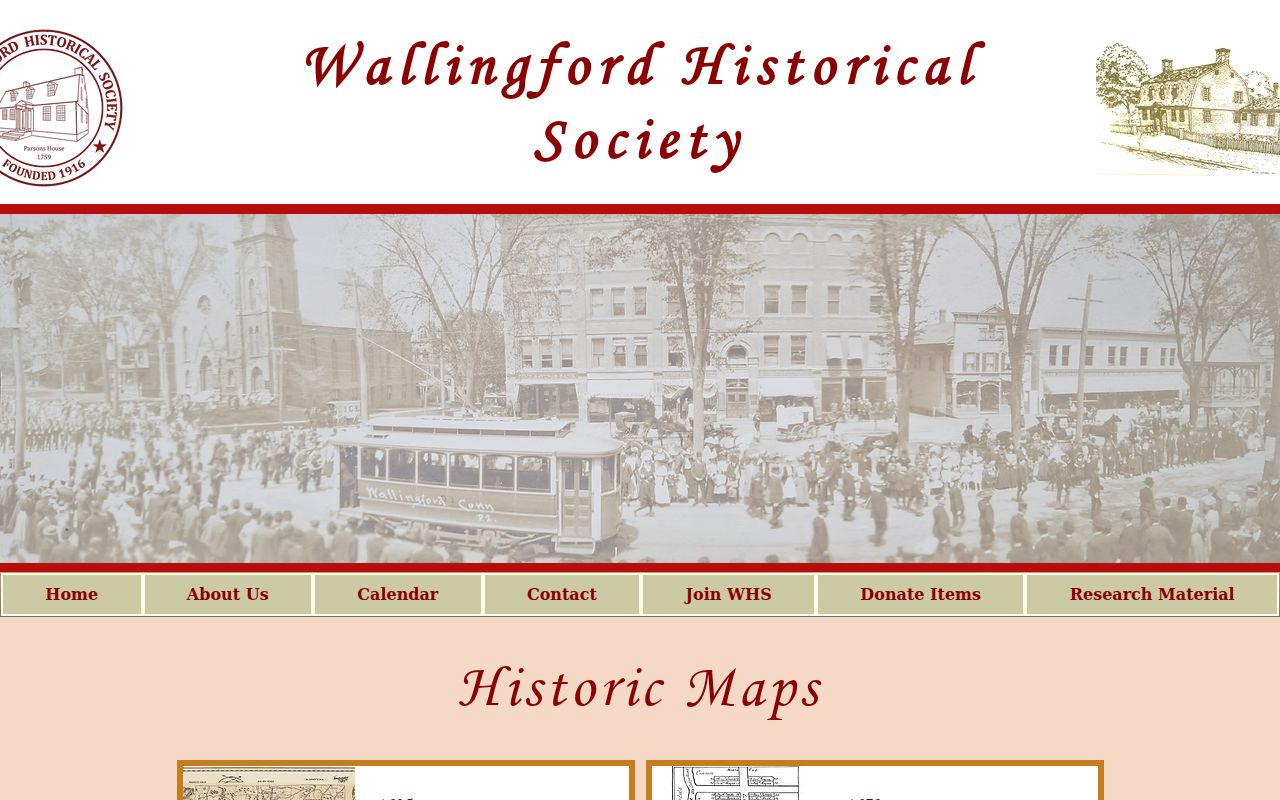
The map list provides dated checkpoints when a present address does not work in an old directory. Use stable landmarks, road crossings, lot shape, and neighboring owners with care. No verified townwide street-renumbering conversion was found, so do not assign an old number to a modern parcel without evidence.
The tax-map legend adds a “lot on other map” clue. MapXpress metadata also recognizes split parcels, combined parcels, lot-number changes, address changes, and boundary adjustments. Each can explain why one modern parcel does not align neatly with an earlier house entry.
Find Wallingford Past Households
Deeds establish interests in land, but previous residents also include people who did not own it. The digitized city directories contain an uneven set of issues from 1883 through 2000. The 1931 volume's numerical section lists streets, householders, and businesses. Start with the house number, open the page image, and cross-check the name in the alphabetical section.
- Choose a documented deed or map date and the closest directory issue.
- Read the numerical street section by house number. Save the page image and printed spelling.
- Confirm each person alphabetically for occupation, spouse notation, or a second address, without treating an abbreviation as a full identity.
- Pair a directory close to 1930, 1940, or 1950 with the public federal census schedule for that census year.
- Mark conflicts and gaps. Do not combine similar names unless dates, address, and other facts support the match.
A criss-cross directory is arranged by address rather than surname. An enumeration district is the geographic unit used to organize census work. The detailed publication runs and reading rules appear on the Wallingford city directory page; the backward trail only needs the issues tied to this one parcel.
Close Wallingford Resident Gaps
An owner or householder may disappear from the next source because of death, a move, estate administration, or a directory gap. Search the Connecticut Probate Court application, then contact the local office for records that require court access. The Wallingford Probate Court is the local district contact; it is not a New Haven County probate clerk.
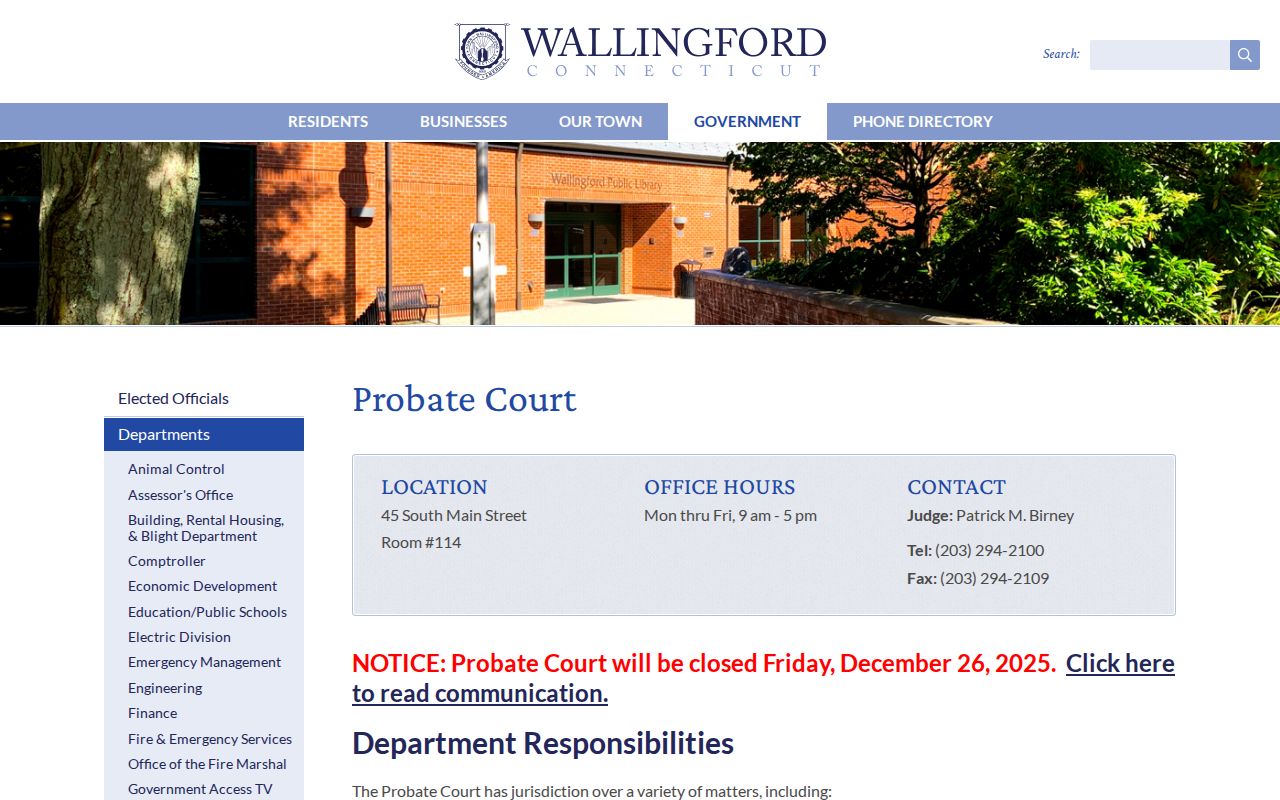
Probate can connect a decedent, estate representative, property, heir question, and transfer date, subject to the case's access rules. Then search Wallingford Public Library newspaper databases and Connecticut Collection clippings for an obituary. No standalone public townwide obituary index was located, so begin with the searchable Journal, Meriden Republican, and Record-Journal ranges and ask library staff for collection help.
The Wallingford Public Library Connecticut Collection is closed-stack and supervised. Staff retrieve material by request or appointment, and items remain on site. That access channel matters when OCR or a web issue fails.
One Wallingford House, Many Roles
The Parsons House at 180 South Main Street shows why labels matter. The Historical Society traces it to 1759 and describes tavern and stage-stop use. Caleb Thompson acquired it in 1805. Eli W. Ives, later identified as both a probate judge and town clerk, also owned it. Today it serves as a Historical Society site.
Those facts come from a house history, institutional history, deed context, and public-office biography. They should not be flattened into one “resident” claim. Use each record for what it proves, state its date and role, and seek the underlying deed or probate file when the research question requires formal evidence.
Handle Wallingford Previous Residents Carefully
A deed party, tax owner, mailing addressee, directory householder, census member, and probate party represent different relationships. Date every result. Historic OCR may be wrong, and the same name can belong to several people. A past address should never be presented as a current location without a current official source.
Connecticut's 72-year census rule keeps schedules after 1950 closed until their release year. Vital, adoption, voter, DMV, and address-confidentiality laws also restrict certain information. Older directory pages are historical snapshots, not consent to track a living person today. Use previous residents research for house history, genealogy, estate questions, or civic study.
Lawful use. Do not use Wallingford address histories to stalk, harass, intimidate, or harm anyone. Honor protected records and living people's safety.